
Heavy Metals: The Hidden Load
Twelve metal fillings, a depression that wouldn’t shift, and the twenty-year experiment that changed how I think about health.
I’ve been called a biohacker before the word existed. I don’t say that to show off — half the time it just meant I was the odd one reading mineral studies while everyone else was reading the football scores. But on this subject, heavy metals, I was years ahead of the curve, and it’s the one piece of my own health story I get asked about most. So here it is, properly — what happened to me, what the science actually says, and what I’d tell you to do (and not do) about it.
Before anything else: talk to your doctor first — especially before any kind of chelation. Some of what I describe below is my personal protocol, not medical advice. If you think metals are a problem for you, ask your GP about proper blood and urine testing. Test, don’t guess.
A mouth full of metal
As a kid I ended up with around twelve amalgam fillings. Looking back, the dentist was, to put it kindly, drill-happy. Amalgam is roughly half elemental mercury by weight, and it doesn’t just sit there inert — it releases a small amount of mercury vapour constantly, more when you chew, grind or drink something hot. For most people the amounts are small. But I had a dozen of them, for decades, and I wasn’t well.
The thing I remember most from those years is the low mood. A long-running, flat, grey depression that never had an obvious cause. I’m not going to claim a study proved my fillings caused it — nobody can prove that for one person. I can only tell you my story in the order it happened.
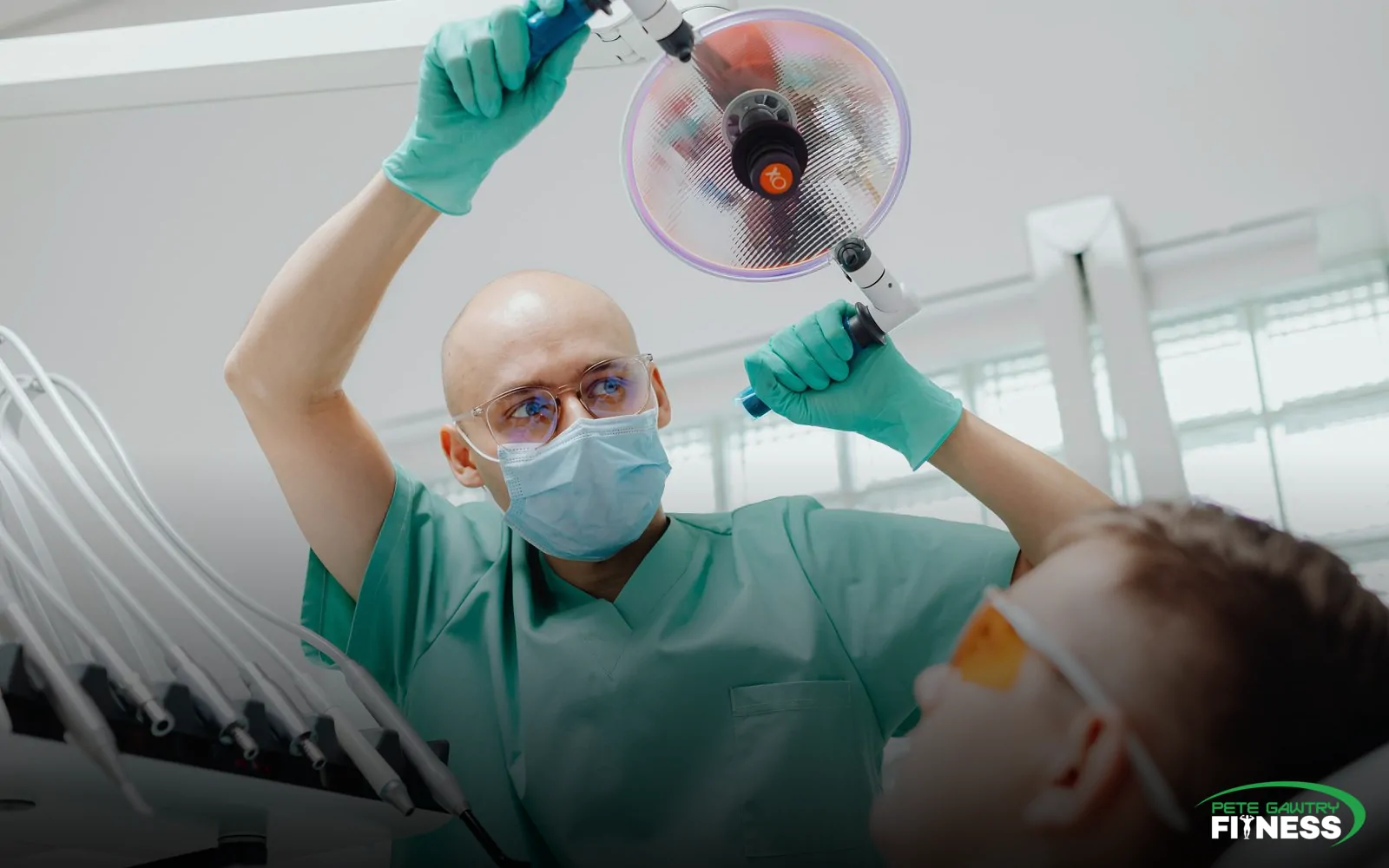
About twenty years ago I had all of them taken out — and this is the bit that matters — by a specialist dentist who knew what he was doing. You do not want old amalgam drilled out casually, because removal done badly can spike your mercury exposure far beyond leaving them alone. Today that careful approach has a name: the SMART protocol (Safe Mercury Amalgam Removal Technique) — rubber dam, high-volume suction, cutting the filling out in chunks rather than grinding it to vapour and dust. If you ever go down this road, use a dentist trained in it. Never a standard drill-and-hope job.
Afterwards I chelated for months — my own way. I used zeolite daily as a binder, and fulvic and humic minerals to put trace minerals back in. And somewhere in those months, the fog lifted. The depression I’d carried for years eased off and never came back the same way. Placebo? Coincidence? Maybe partly. I genuinely don’t care. I got my head back.
Since then I’ve done a detox reset every six months, ditched aluminium antiperspirants, and stopped wrapping food in tin foil. Twenty years on, that’s still my rhythm.

Honesty box: zeolite and fulvic minerals are the part of my story with the thinnest human evidence. Zeolite binds things in the gut — that much is real chemistry — but good human trials showing it lowers your body’s stored metal burden are scarce. I’m telling you what I did and how I responded, not claiming a proven treatment. The proven end of this field is doctor-supervised chelation, and that comes with real risks of its own — more below.
Where the load actually comes from

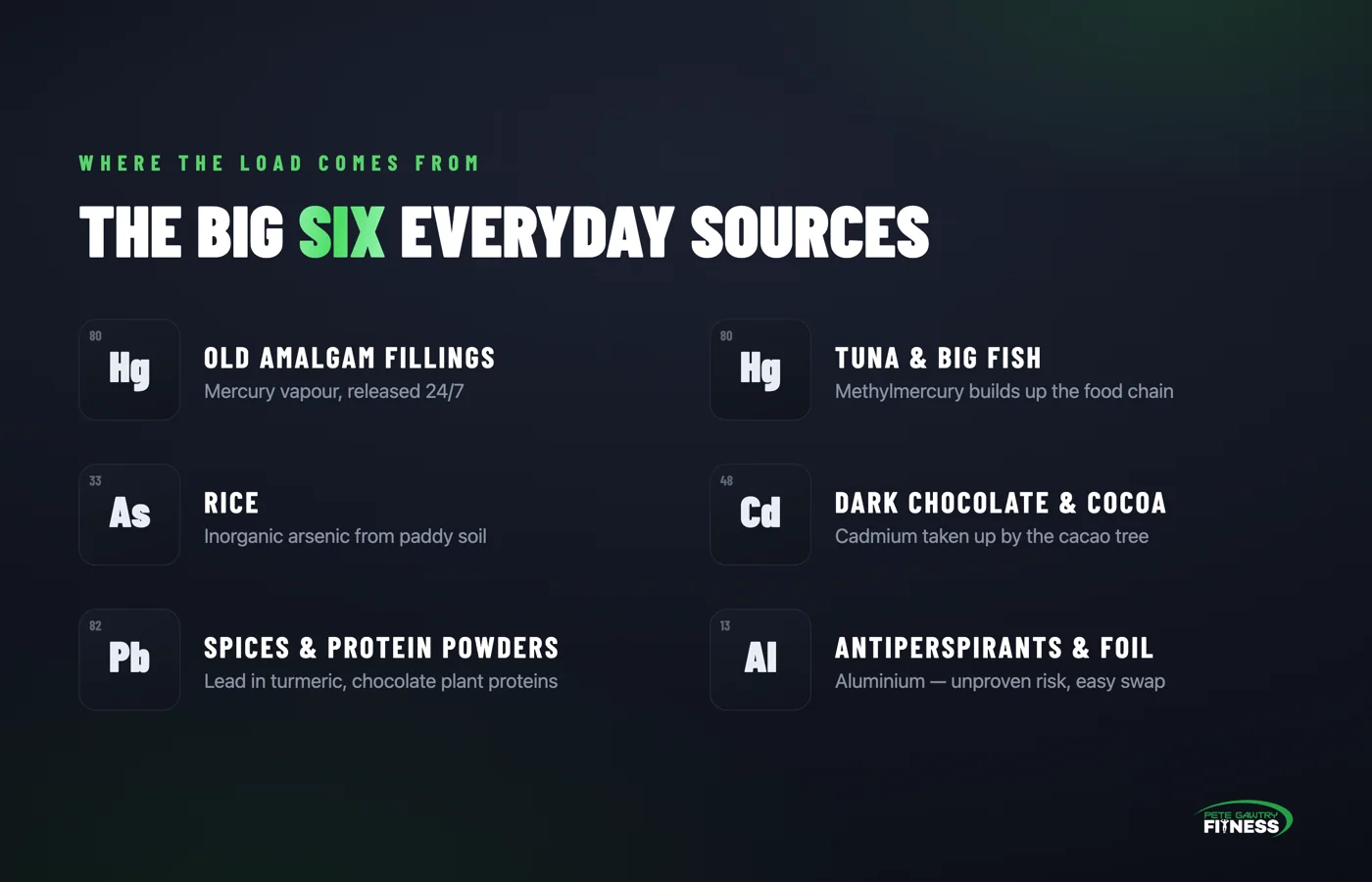
1. Old amalgam fillings — mercury
Still the biggest single source of mercury vapour exposure for people who have them. In 2020 the US FDA advised that certain groups — pregnant and nursing women, women planning pregnancy, children under six, and people with kidney or neurological conditions — should avoid new amalgam fillings where possible. That’s not a fringe website talking; that’s the regulator. If yours are old and intact, the sensible options are: leave them alone, or have them removed properly by a SMART-trained dentist. Nothing in between.
2. Tuna and big fish — methylmercury
Mercury builds up the food chain, so the big, old predators carry the most. UK guidance (NHS/Food Standards Agency) is blunt about the worst offenders: pregnant women should avoid shark, swordfish and marlin entirely, and limit tuna to about four cans or two steaks a week. For the rest of us the same logic applies in softer form. I lift weights and eat a lot of protein, and plenty of lifters live on tuna — if that’s you, pick skipjack (the small, short-lived species in most standard tins) over albacore and big steaks, and rotate in other proteins. Fish is still good food. Dose makes the poison.
3. Rice — arsenic
Rice pulls inorganic arsenic out of paddy soil better than almost any other crop. The fix is beautifully low-tech: cook rice like pasta. Six to ten parts water to one part rice, then drain the excess — studies show that removes roughly 40–60% of the inorganic arsenic. Rinsing alone does very little. White rice carries less than brown. Worth knowing if rice is your everyday carb, and doubly worth knowing for kids.
4. Dark chocolate and cocoa — cadmium (and lead)
Cacao trees take cadmium up from the soil, and lead tends to land on beans drying in the open air. When Consumer Reports tested dark chocolate in 2022–23, 43% of products exceeded California’s lead threshold and 35% exceeded it for cadmium. The darker the chocolate, the more cocoa solids, the bigger the dose. I’m not telling you to bin the 85% bar — I’m telling you a couple of squares is a better idea than half a slab a night.
5. Spices and protein powders — lead
Two sneaky ones. Cheap or loose-sold turmeric has been repeatedly caught contaminated with lead (in some documented child lead-poisoning cases it was the main source), so buy spices from big, tested brands. And in 2025 the Clean Label Project tested 160 protein powders: 47% exceeded California’s Prop 65 lead limit — with chocolate-flavoured powders carrying around four times the lead of vanilla, and plant-based powders roughly three times more than whey. (Industry groups dispute how alarming those thresholds are — Prop 65 limits are deliberately strict — but the pattern across flavours and bases kept repeating.) My simple rule: vanilla whey beats chocolate plant protein on this front.
6. Antiperspirants and tin foil — aluminium
Let me frame this one honestly, because it gets overcooked online: the major cancer bodies (the American Cancer Society and the US National Cancer Institute among them) say there is no established link between aluminium antiperspirants and breast cancer. What is true: aluminium salts are absorbed in tiny amounts, the FDA requires a “ask a doctor if you have kidney disease” warning on antiperspirants, and aluminium leaches into food from foil — especially with acidic, salty or hot food. I switched to aluminium-free deodorant and stopped cooking on foil twenty years ago. That’s a precaution, not a proof — it costs me nothing and removes a daily exposure I don’t need. You can make your own call on that one.
Getting it out — the honest version
This is where the internet gets silly, so let’s keep our feet on the floor. There are three tiers.
Medical chelation — the proven tier
For genuine, tested heavy-metal poisoning, doctors use prescription chelators — DMSA orally, EDTA by IV, and related agents. They work, and they are serious drugs: they can crash your calcium, strain your kidneys, and strip essential minerals like zinc and iron along with the bad stuff. People have died from chelation done wrong. The FDA has never approved any over-the-counter chelation product — anything sold that way is unregulated at best. If you suspect real poisoning: GP, blood and urine tests, referral. That path exists and it works.
Binders and minerals — my tier
Zeolite, fulvic and humic minerals, and similar supplements sit in the middle: real chemistry (they do bind things in the gut), thin human evidence for lowering stored body burden. This is what I used, alongside getting the source (my fillings) removed properly — and I’d never have done it while the fillings were still in. Removing the tap matters more than mopping the floor. If you go this route, tell your GP what you’re taking.
Activated charcoal — the narrow tool
Charcoal is brilliant at one thing: adsorbing what’s currently in your gut — it’s what A&E uses for some acute poisonings. It does not pull stored metals out of your tissues, and taken routinely it binds nutrients and medications too. Occasional tool, not a daily habit.
And the free stuff works quietly in the background: sweat regularly (training covers that), eat enough fibre and cruciferous veg, drink proper amounts of water, and keep your protein up so your body has the raw materials for its own detox systems — your liver and kidneys are the best chelators you own.

What I’d tell you to do
- Cut the intake first — the six swaps above cost nothing and start today.
- Got old amalgams and want them gone? SMART-trained dentist only. Never a standard drill-out.
- Suspect a real problem? GP first — proper testing beats guessing, every time.
- Chelation is a medical procedure. Doctor-supervised or not at all.
- Train, sweat, eat well, sleep — the boring fundamentals are also your detox plan.
Twenty years ago people thought I was mad for asking my dentist what my fillings were made of. Now the FDA publishes warnings about the exact groups who shouldn’t get them. Sometimes being ahead of the curve just means being patient.
— Pete
This article is my personal experience plus a plain reading of published guidance (FDA, NHS/FSA, Consumer Reports, Clean Label Project, major cancer bodies). It is not medical advice, and I’m not a doctor. If you’re pregnant, breastfeeding, have kidney problems, or are considering chelation in any form, speak to your GP first.
Want a coach who sweats the details?
This is the level of thought that goes into everything I do — training, food, recovery, the lot. Your first consultation with me is free.
Book a Free Consultation