
01
One coach. One standard.
Your entire team is coached by the same award-winning UK PT, not 200 different freelancers on a marketplace. Consistent quality, consistent culture, consistent results.
Your people lose 49.7 productive days each to poor health. I need eight percent of that back. Not an app and not a gym discount — your company's own fitness league, coached by me, with a champion crowned every month. £1,500 a month for a team of 30, plus a one-off £2,000 setup. From year two, about £11.50 per employee, per week, with a real coach running it, not a dashboard.
Sick days are the part you can see. Depending on whose count you use, that is 4.4 days per worker across the whole labour market (ONS), or 9.4 days per employee in the average organisation (CIPD’s survey of 1,100 HR professionals) — the highest that figure has been, against 5.8 before the pandemic.
That number is real, and it is nowhere near the whole cost. Once you count the people who are at their desk but running on empty — the ones who came in with a migraine, who haven't slept properly in a fortnight, who are managing a bad back through a full day of meetings — the figure is 49.7 productive days per employee. Whichever absence number you started from, you are looking at somewhere between a tenth and a fifth of the real cost.
The gap · days per employee per year
Same zero, same unit, same scale. Two very different views of the working year.
9.4
49.7
6.1 formal absence · 43.6 presenteeism
Common zero · linear scale
Sources: ONS, 2025 (4.4 days per worker) · CIPD Health and Wellbeing at Work, 2025 (9.4 days per employee) · Britain's Healthiest Workplace, run by Vitality with RAND Europe, Cambridge and Mercer (49.7 total productive days lost). Two different measures, shown together deliberately.
Deloitte price the presenteeism half of it at roughly £24bn of the £51bn a year that poor mental health costs UK employers. It is the largest single component, and it is the one no absence policy has ever touched.

It is worth being precise about why people are off, because it decides what an employer can sensibly do about it. The Health and Safety Executive counts 40.1 million working days lost a year to work-related ill health and workplace injury.
Two things take most of it: 22.1 million days to stress, depression or anxiety, and 7.1 million to musculoskeletal problems — backs, necks, shoulders, knees.
Where the days go · UK · 2024/25
One tile is one per cent of the 40.1 million days.
100 tiles · exact percentage split
Source: HSE, Summary statistics for Great Britain, 2024/25 — Accredited Official Statistics. Percentages are of the 40.1m total.
On the musculoskeletal half — specifically low back pain — this stops being an association and becomes a clinical recommendation.
NICE guidance to the NHS on low back pain is to “consider a group exercise programme” — not as a lifestyle note at the end of the leaflet, but as management of the condition. Underneath it sits a Cochrane review of 249 trials and more than 24,000 people, which found exercise reduced pain by around 15 points on a 100-point scale against no treatment or usual care.
For low back pain, exercise isn’t the alternative to treatment. It is what the national guideline recommends.
The bigger half of that chart — stress, depression and anxiety — is not something a training programme treats, and I’m not going to borrow the evidence from the other half and pretend it is. My side of that one is narrow and unglamorous: a fixed appointment in the week, other people in the room, and something to be good at that isn’t work. Worth having. Not a treatment, and not what I’d ask you to buy this on.
Offices produce those backs for unexciting reasons: hours in one position, with almost none of the loading the muscles that hold a spine steady are supposed to get. The usual employer answer is equipment — a chair assessment, a standing desk, a footrest. All fine, and all aimed at making the sitting less bad rather than at the thing that changes the outcome. A better chair doesn’t load anything.
That is why two of every five sessions in the programme are desk-mobility work and the strength sessions lead the week. It is the unglamorous version on purpose.
To be clear about the limits: this is training, not treatment. Back pain with numbness, weakness, or pain that wakes someone at night belongs with a clinician first, and I’d say the same to any of my own clients. What a programme is for is the ordinary, mechanical, recurring trouble that people have learned to work around — which is the kind the exercise evidence is about.
The full research behind all of this — the sources, the numbers, and the parts of it I think are oversold — is written up here: Your wellbeing budget isn’t the problem. The turnout is.
The average UK employer already runs 47 separate wellbeing measures. Cycle schemes, EAP lines, gym discounts, apps, webinars, a mental-health first-aider.
A quarter of staff use them. Of the people who do, 85% say they help. So the support works. It just doesn't reach anyone.
The turnout gap
One mark is one employee. Roughly 47 health measures are on offer to all of them.
Each mark = 1 employee · exact 25/100 split
Source: Britain's Healthiest Workplace, 2023. 47 interventions offered on average; 25% take-up; 85% of users found them useful.
A benefit nobody opens returns nothing, whatever it cost.
This is the whole game. Every platform in this market sells you access — a network of 110,000 gyms, a library of 50,000 classes, an app with a step counter. Access has never been the bottleneck. Turning up is.

Your team is already losing 49.7 productive days each. Recovering just four of them back — eight percent — is the break-even point from year two: at a £150 working day that’s £600 per employee per year, or £11.50 a week, covered. Year one also carries the one-off £2,000 setup, so full break-even in year one is closer to four and a half days.
Break-even · productive days per person
Against 49.7 productive days lost, this is the entire ask.
4 days = 8% · the other 45.7 are still lost
Put your own day rate in. A fair starting point is salary ÷ working days.
Illustrative break-even frame, not a forecast
The £150 working day is deliberately conservative: ONS median full-time pay was £39,039 in April 2025, roughly £172 a day before employer NI and pension. Put your own day rate in — if your people are worth more than £150, it pays back faster.
Wellhub and ClassPass give your staff access to gyms. Challenge apps give them a step counter and a dashboard, and sell the "head coach" as a paid extra. I've looked hard and I haven't found anyone else in the UK doing this: a named, award-winning coach running your company's own league, in his own app, with real programmes behind it. If you find someone, tell me — I'd genuinely like to see it. That's the product.
Your entire team is coached by the same award-winning UK PT, not 200 different freelancers on a marketplace. Consistent quality, consistent culture, consistent results.
Two of every five weekly sessions are 10-15 minute desk-mobility programmes. Lower back, neck, shoulders, hips, exactly what 8 hours at a screen wrecks.
You see a delivery report — sessions delivered, sessions cancelled and seats under contract. You don't see individual employee data, and no participation or attendance percentages are produced at all: on a staff list you can read by name, those work back to individuals. Your staff know that. Higher engagement, GDPR-safe.

Healthier, more energised teams, that's the goal, and what your staff become.
Strength training is an important part of long-term health — particularly for maintaining strength, muscle and bone as people age, alongside the metabolic and cognitive benefits linked to regular exercise generally. So it leads every plan. Around it I add the right amount of conditioning and mobility. Your team isn’t training for a bodybuilding show — they’re building a body that feels better at 5pm than it did at 9am, and still does in twenty years.
The result: a balanced, strength-first week any employee can stick to, regardless of starting fitness, age, or whether they've ever set foot in a gym.
This is the same engine behind the PG League my own clients compete in, built for your company. Every healthy thing your team does, a coached workout, a run, 10,000 steps, a swim, a proper night's sleep, water, their supplements, earns points. The table drops fresh every Monday. Each month one person is crowned champion and gets a real medal, and one name takes the whole season every quarter. It turns "I should get healthier" into "I'm not losing my streak."

Sales · showing her name (opted in) · 21-day streak
Sample team board, illustration only. Taking part is always voluntary. Names show as initials by default; staff opt in to show their full name (like Sarah, above) or opt out entirely. HR only ever sees the anonymised totals below, never an individual's data. Fully GDPR-compliant, and every health message stays within UK advertising rules.
No single "workout-only" metric that punishes a 55-year-old who walks and swims. We score every healthy action, then weight it by how much we can verify it, so the points are real and the board can't be gamed.
Point weights are tuned per company on the discovery call, an office team and a warehouse team don't score the same. The principle never changes: verifiable effort is worth more than a typed-in number.
If it's any harder than a single tap, people won't do it, so we made it a single tap. Each morning the app shows that person's own stack. They tap what they took. Done. That tiny daily action is the hook that keeps the whole app open.
A leaderboard is only worth having if the numbers are real. We make the honest path the easy path, no one ever feels policed, and the board stays something staff actually trust.
The biggest points come from data the app captures itself, a coached session ticked off in-app, your phone's step count, cardio you photo-log. You can't fake your phone's step count or a coach-signed workout, so the top of the board is earned, not typed.
People love proof. A quick gym selfie, a shot of the machine they're on, the scales, earns bonus points and an optional "shared" badge. It's framed as bragging rights, not surveillance, so we get the photo evidence without ever making it a requirement.
Behind the scenes, impossible patterns, a two-hour run with zero steps, copy-paste entries, odd timing, get flagged to me, the coach. Never to colleagues, never on the board. Nobody feels watched; the numbers stay clean.
Reward the behaviour and the behaviour repeats. Tie real perks to the Move Score and you build a culture where being healthy is the win, for them and for you.
Daily nudges and a live board make showing up the easy, fun choice, not a chore.
Every healthy action earns points. Verified effort is worth the most, so honesty wins.
Rewarded behaviour repeats. Fitter, more energised, more focused people week after week.
The goal: fewer sick days, lower absence cost, higher productivity. Healthier team, healthier bottom line.
Tie whatever rewards you like to the board, your call, your budget:
Step challenges fizzle out after a fortnight. A league doesn't, because there's always something to win next.
The table drops. Fresh week, fresh race, last week's winner has a target on their back.
A champion is crowned and a real medal lands on their desk. Watch what that does to an office.
One name takes the season. Optional extra: a Champions Day at my Leeds studio to hand it over properly.
17 badges to earn, streaks to protect, and an office TV mode so the whole floor knows who's top.

The same badges my own clients chase. See how the League works →

Inside the app, your company gets a private group of its own, colleagues training together, cheering each other on, and chasing the monthly leaderboard. It turns "I should get fit" into something the whole office is doing together.
Your team gets the same library your staff would get one-to-one, and every movement in it is animated — which is most of the reason a beginner actually starts. Here is a corner of it, rotating.
See the whole training library →
Women between 45 and 55 are often the most experienced people in a business. They are also the group most likely to be working through menopause symptoms — broken sleep, joint pain, brain fog, energy on the floor — and the least likely to mention it to anyone.
Most corporate wellbeing packages have nothing for them. A gym network and a meditation app don't touch this. Menopause and midlife women's coaching is one of the main reasons women find me in the first place, and your team gets that same coaching as part of the package.

In February 2024 the Equality and Human Rights Commission published guidance on what employers owe staff going through menopause.
Menopause is not a protected characteristic in its own right. But how symptoms are handled can amount to sex, age or disability discrimination, and where symptoms are severe and long-lasting enough to meet the disability threshold, there is a legal duty to make reasonable adjustments. Tribunal claims referencing menopause have been rising for years.
I'm not a lawyer, and this is not a compliance product. What I'd say is this: a gym discount is not a positive step. A named coach running a documented programme aimed squarely at this group is a much better answer to "what have you actually put in place?"
Nobody has to declare anything. Nobody goes on a list. It isn't a medical service — anyone with symptoms should talk to their GP or a menopause specialist about treatment. My side is the training, the nutrition, the sleep and the strength.
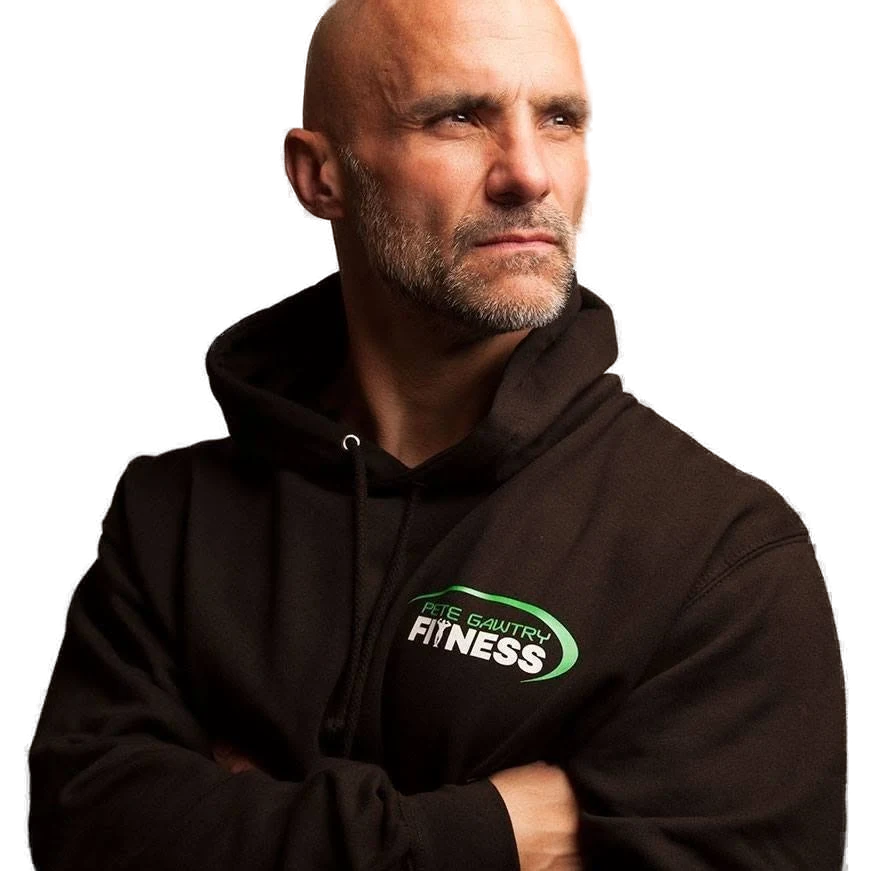
Me. Not an account manager, not a marketplace of freelancers, and not a rota. Every programme on this page is written by hand by one coach and delivered by the same one.
I’m Pete Gawtry. 12 awards, 4× UK’s Best PT, coaching out of my own studio at Suite 1, Arena Business Park, Tarn Lane, Leeds, LS17 9BF, and online across the UK. The trophies are all listed with the year and the awarding body if you want to check them: the trophy cabinet. You can also walk round the studio before you talk to me.
That is the trade-off, stated honestly: one coach is the reason the programme reaches people that a platform never does, and it is also the reason there is a limit on how many companies I take at once. If the timing matters to you, ask on the call.
One flagship package: £1,500 a month for a team of up to 30, plus a one-off £2,000 setup (teams over 30 add £80 per extra head to the setup, once). Beyond that, no hidden extras and no per-feature nonsense.
Your company league, fully coached. This is the one.
Plus a one-off £2,000 setup. Min 3-month term, then rolling monthly · about £11.50 per employee per week from year two
31-99 employees.
On top of the Team of 30 package · e.g. 50 staff = £2,500/mo
100+ employees.
Whole-company rate · e.g. 100 staff = £4,000/mo · custom quote
A single one-off to get your company up and running: every employee onboarded, their programme built by hand, and your league live with a table on it. Charged once, alongside your first month — then it is simply the monthly plan.
Charged once, with your first month. Larger team? Add £80/head over 30.
The largest randomised trial of workplace wellness ever run followed 4,834 employees over two years. The measured effect on sick leave was +0.186 days — statistically insignificant. Nothing.
It found something else worth knowing, too. The people who volunteer for wellness programmes had already been taking more sick days than their colleagues before the programme started. That single fact is what inflates almost every "we cut absence by 30%" chart you will be shown this year.
So when a provider tells you their platform will cut your absence, ask them for the study. Most cannot produce one. Here is mine, and it says the opposite of what I'd like it to.
What I will promise is narrower and, I’d argue, more useful: you’ll get your own monthly delivery report — sessions delivered, sessions cancelled and seats under contract, names off — so you can see exactly what you paid for actually happened, not a national average or a vendor’s case study.
That won’t tell you whether health outcomes are changing — no monthly report can — but a stalled rollout shows up in month two instead of at renewal.

Looking after your team’s health is good for your people, and it’s usually tax-efficient too. (Treatment depends on how it's set up, so always confirm the detail with your accountant.)
Staff wellbeing spend is normally an allowable cost for Corporation Tax, so a chunk of every pound comes back through a lower tax bill. Pete Gawtry Fitness is not currently VAT-registered, so no VAT is charged on these invoices.
HMRC lets you give every employee one health-screening and check-up a year, completely tax-free. Our fitness & wellbeing MOT slots right into that allowance.
The Government's "Get Britain Working" and "Keep Britain Working" agenda puts employer-led prevention front and centre. A structured programme gets you ahead of it.
A note on honesty: employer-paid gym memberships and fitness apps are normally a taxable benefit-in-kind, there's no magic "wipe out your tax bill" scheme, and we won't pretend otherwise. The genuinely tax-free items are the annual health check, welfare counselling and return-to-work treatment; everything else simply benefits from being a deductible cost. We'll show you exactly what applies, your accountant signs it off.
Tell me about your team, current wellness setup, what you want to move the needle on. I confirm pricing and timeline.
Signed agreement, DPA in place, your brand on the app's launch screen, employee comms drafted.
30-min live session with your team. Staff get their magic-link invites at the end. PAR-Q + onboarding questionnaire takes them 6 mins.
Programmes delivered weekly, check-ins ongoing, leaderboards live. You get one report a month: sessions delivered, sessions cancelled and seats under contract.
Wellhub and ClassPass give your staff access to gym networks, they don't coach them. Most employees use the perk for a week and drop off. This is the opposite: real coaching, real check-ins, with one named coach (me). It complements a Wellhub-style benefit rather than replacing it.
I'm the data controller for individual fitness data (height, weight, training history, photos if opted-in). Your company is controller for the employee list you share with me. HR sees a delivery report for the company — sessions delivered, sessions cancelled and seats under contract for a completed month. Deliberately no participation rate, no attendance percentage and no weight figures: on a staff list you can read by name, those numbers can be worked back to individuals, so they are not produced at all. Individual data never goes back to HR. Full DPA available on request.
Brilliant, they keep doing it. The 3+1+1 programme is designed to slot around existing activity rather than replace it. We discuss this in the onboarding questionnaire and the plan flexes.
There is an initial three-month commitment, then it rolls month to month. The setup fee is a single one-off, and the three months give us time to run a full monthly cycle or two and prove the case. After that, 30 days’ notice either way.
The app is "Pete Gawtry Fitness", that's the named coach. Your company branding goes on: the launch screen welcome, the launch comms, the leaderboard, and the team Slack/Teams channel. The coach branding stays mine because that's what people trust, a person, not a logo.
£5m Public Liability + £2m Professional Indemnity through a Level 4 PT-specific underwriter. Cert available on request. PAR-Q completed by every employee before any programme is issued.
A one-off £2,000 setup fee on signing for a team of up to 30, plus £80 for each extra employee above 30 (so 50 people is £3,600), invoiced BACS or card alongside your first month. From then on it is simply the monthly package: £1,500/month for a team of up to 30, then £50/month per extra employee (100+ staff move to a £40/head whole-company rate). Invoiced monthly, quarterly in advance if your finance team prefers. Stripe Quotes for clean PO matching.
Online PT is location-agnostic, the programme works the same in London, Edinburgh, or remote-from-home. The quarterly in-person visit (Growing team) is for Leeds 30-mile-radius teams; remote teams get a 1:1 video call with me instead.
Two minutes now saves a long call later. I'll come back with a tailored number and a launch date, usually same working day. No hard sell, no auto-emails.