
How Much Sleep Do You Actually Need?
Eight hours is the middle of a range, not a pass mark. Here’s how to work out your own number, why the time you go to bed matters nearly as much as the total, and the handful of things that actually make a difference.
Eight hours is an average. It was never meant to be a rule, and somewhere along the way it turned into a pass mark.
I’ve had clients describe lying there at half eleven doing arithmetic. Six and a half if I drop off now. Six and a quarter if I don’t. And the arithmetic itself keeps them awake another twenty minutes. That’s a daft way to spend an evening, and it comes from treating an average as a target.
Sleep comes up in nearly every consultation I do. Not usually as the headline, because people book me about their weight or their back or their strength. It comes up about ten minutes in, when I ask how their week actually runs and somebody says “well, I’m knackered all the time, but that’s normal isn’t it.” It’s common. That’s not quite the same as normal.
So here’s the honest version. Where the eight-hour figure came from and what it actually describes. Why your number might be seven and your partner’s might be nine, with nothing wrong with either of you. How to work out which one you are. And the part almost nobody gets told, which is that when you sleep does nearly as much work as how long for.
Where “Eight Hours” Came From
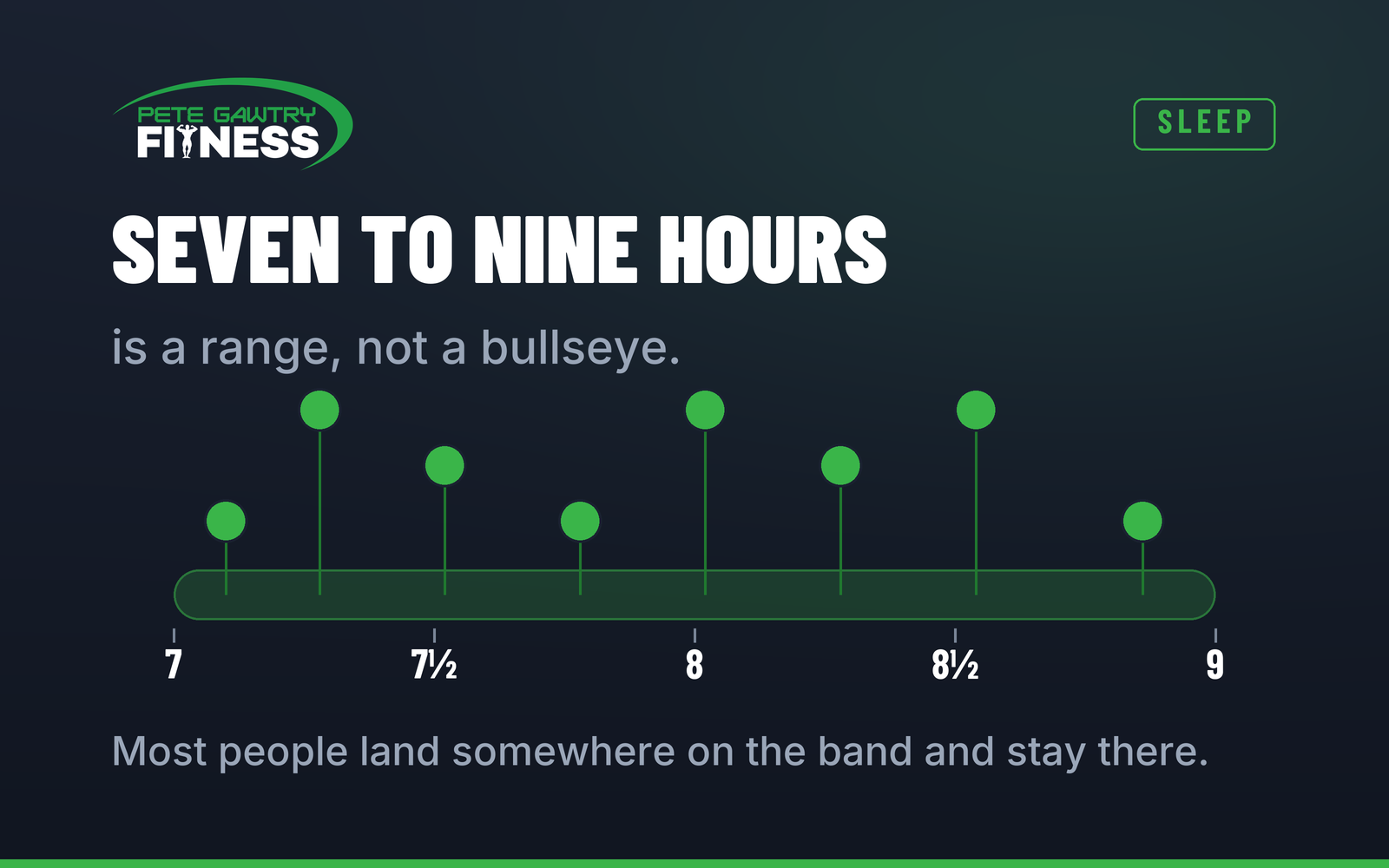
The general guidance for adults sits at seven to nine hours a night. Eight is simply the middle of that range. It’s a useful number if you’re writing health advice for a whole country. It’s close to useless for planning your Tuesday.
Think about how we use averages everywhere else. The average British man is around five foot nine. Nobody looks at a bloke who’s six foot two and tells him he’s doing height wrong. But we’ve somehow decided that the middle of the sleep range is the correct answer and everything either side of it is a failure.
The range is seven to nine for a reason. It’s wide because people are different, and the people who wrote it knew that.
The Range Is The Whole Point
Some adults do genuinely well on a bit over seven. Others need a solid nine and are miserable on anything less. Both are ordinary. Neither is a character flaw.
Your own number isn’t fixed either. It shifts with what your life is asking of you. A week with four hard training sessions and a work deadline takes more out of you than a quiet week does, and you’ll want more sleep to match. Coming back from a bug, the same. A stretch of broken nights with a small child, obviously the same.
There’s also a certain type of person who’ll tell you they only need five hours. I’ve met plenty. Most of them need more than five hours. They’ve just been running short for so long that they’ve forgotten what rested feels like, and they’ve built an identity out of it. If you’re one of them, no judgement. But have a proper think about whether you’re genuinely fine or just used to it.
How To Work Out Your Own Number
You don’t need a gadget for this. You need two weeks and a bit of honesty. Here’s what I ask clients to look at.
- How you are mid-afternoon. Not first thing, when everyone’s rough. Around three o’clock on a normal working day, before you’ve topped yourself up with coffee. If you’re steady and getting on with things, you’re probably getting enough. If three o’clock is a daily struggle you’ve quietly built your whole day around, you probably aren’t.
- Whether you need the alarm. People who are getting enough sleep tend to surface a few minutes before it goes off, at least some of the time. If the alarm rips you out of nowhere every single morning and you snooze it twice, that’s information.
- How fast you drop off. This one surprises people. Being unconscious within a minute of your head hitting the pillow isn’t a sign you’re a brilliant sleeper. More often it’s a sign you were running short. Taking ten or fifteen minutes to drift off is perfectly normal.
- The holiday test. This is the best one going. First few days of a week off, no alarm, nowhere to be. How long do you actually sleep? If you go nine and a half hours for four nights straight before it settles down, you’d been carrying a shortfall for months and didn’t know it.
- The weekend gap. If you’re on six hours fifteen on a weeknight and nine and a half on a Saturday, you’ve already got your answer. That gap is the debt.
If you want to be properly systematic about it, pick a fortnight where nothing much is happening. Go to bed when you’re genuinely tired rather than when you think you should, get up without an alarm, and see where it lands by the end of the second week. Whatever it settles at is your number. Then build your normal weeks around that instead of around eight.

Regularity Does More Than People Expect
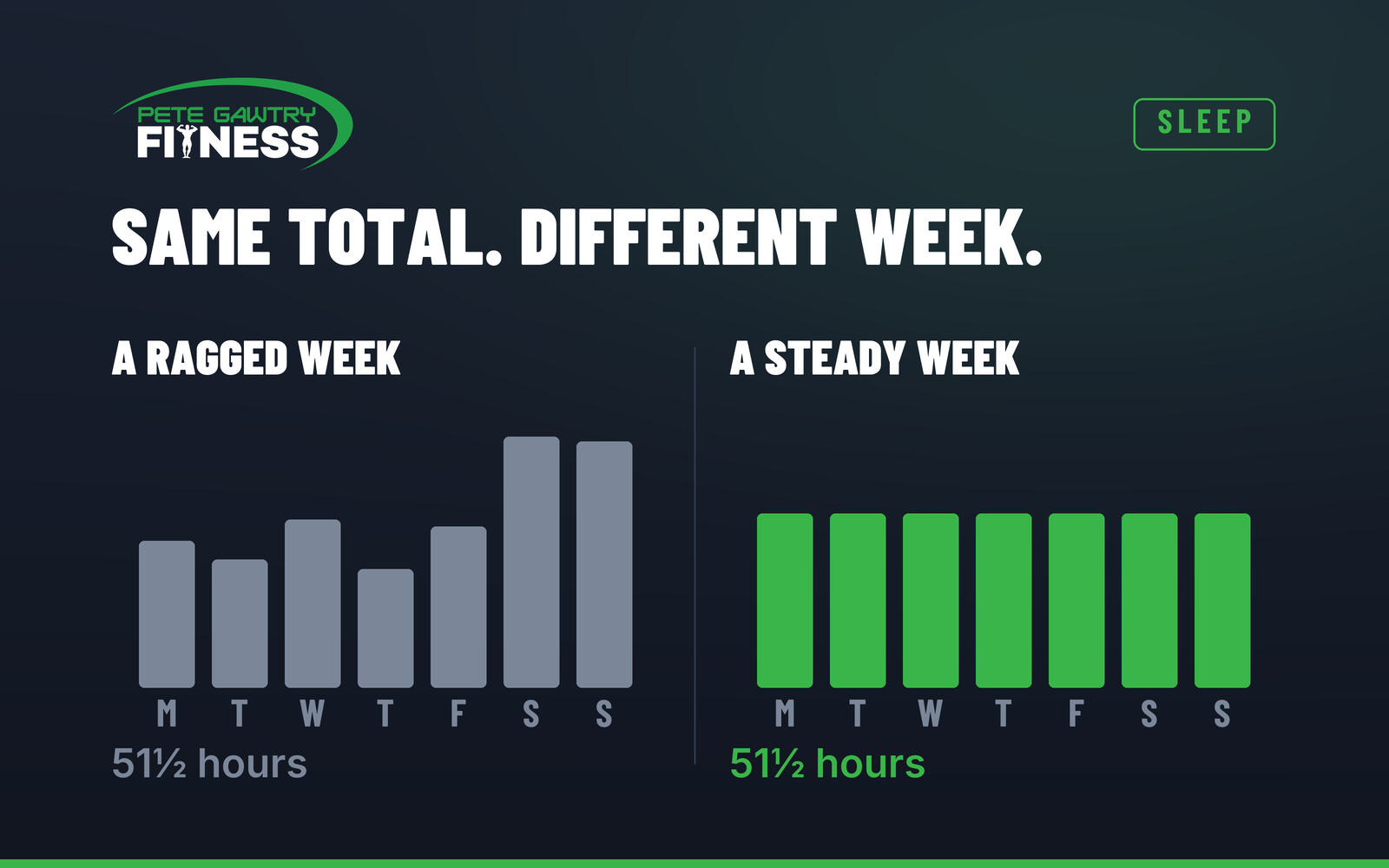
This is the bit that gets left out of most sleep advice, and it’s the one that changes how my clients feel fastest. Ten till six every night beats a chaotic week that adds up to more hours. Midnight till nine on Tuesday, ten till five on Wednesday, then two till eleven at the weekend is a lot of hours on paper. It usually feels far worse than a boring, regular seven and a half.
Routine does a lot of the work for you. When the times keep moving around, nothing settles, and you end up with the version everyone recognises: wide awake at eleven, wrecked at seven.
Anchor the wake time, not the bedtime. Bedtime drifts, because life happens. Somebody rings, the match goes to extra time, the kids won’t settle. Wake time you can actually hold, and holding it does most of the work on its own. Pick one, keep it within about an hour seven days a week, and let the bedtime sort itself out. It will, within a fortnight or so, because you’ll get tired earlier.
The weekend swing is where most people undo themselves. Up at six on Friday, up at midday on Sunday. That’s a six-hour shift in two days. You’ve effectively flown to another time zone and back without leaving Leeds, and then you wonder why Sunday night is a write-off and Monday feels like wading through treacle.
Can You Catch Up At The Weekend?
Partly. A lie-in after a rough week genuinely helps and I’d never tell anyone to skip one. What it doesn’t do is square the books. You can’t run four nights of five and a half hours and then settle it with one big Sunday.
The practical rule I give people: cap the lie-in at about an hour, hour and a half past your usual time. Take more than that and you’ll not be tired at ten on Sunday night, you’ll be up till one, and Monday’s already gone before it started. The lie-in that felt like a treat costs you the first two days of the week.
If the weeknights are the problem, fix the weeknights. That’s less fun and it works considerably better.
What Actually Works
None of this is clever. It’s the same short list I’ve given clients for years, and it holds up.
- Pick a wake time and hold it. Within an hour, seven days a week. This is the single highest-value change on the list and most people never try it properly.
- Work backwards and treat it as an appointment. If you’re up at six and you want seven and a half, you’re asleep by half ten, which means you’re heading up around ten. Put it in the diary the way you’d put a session in the diary.
- Give yourself half an hour to wind down. You can’t go from answering emails at 22:58 to asleep at 23:00. Get the lights and the screens down and do something dull. Reading, a shower, tidying the kitchen. It doesn’t matter what it is as long as it’s the same thing most nights.
- Move your caffeine cut-off earlier. Caffeine hangs about far longer than people expect. A four o’clock coffee is often still with you at bedtime. Try a fortnight with nothing after about two and see what happens.
- Be honest about the wine. A couple of drinks will get you off to sleep faster. They also tend to make the second half of the night less settled, and that’s the half you actually notice the next day. That’s not me telling you not to drink. It’s me telling you not to be surprised.
- Keep the room dark and cool. Boring, and it works. A cheap eye mask has sorted more sleep problems than most of the things people spend real money on.
- Don’t lie there fighting it. If you’ve been awake a good while and you’re getting annoyed about it, get up. Keep the lights low, leave the phone where it is, and do something dull. Go back when you feel heavy rather than when you feel you ought to. Lying there getting frustrated just teaches you to associate the bed with being frustrated.
- Keep the bed for sleep. The laptop and the work email can stay downstairs, and so can the hour of scrolling.
Pick two of those. Do them for a month. Don’t try to do the whole list on Monday, because you won’t, and then you’ll decide the list doesn’t work.
When None Of This Touches It
Sometimes the sensible stuff isn’t enough, and I want to be straight with you about where my job ends.
If your nights have been genuinely bad for a long stretch, if you’re doing all of the above properly and you’re still waking up wrecked, that’s a conversation for your GP. Not for me, and not for the internet. I’m a personal trainer. I can help you build a sensible routine and I can help you train around a rough week, but I’m not qualified to work out why your sleep is the way it is, and neither is anyone else selling you something.
Go and get it looked at properly. It’s a short conversation and it’s the right person to be having it with.
Where This Sits Next To Your Training
The reason I care about any of this is what it does to the rest of the week. Not in some grand way. In the ordinary way where a short night turns into a shorter session, the session turns into a skipped one, and by the end of the month the training log doesn’t add up to what you thought you’d done.
I’ve written that up separately, because it deserves its own piece: why your training stalls when you’re not sleeping. If you’re lifting regularly and the numbers have gone flat, it’s worth ten minutes.
Quick FAQ
Is eight hours a night right for everyone?
No. Eight is the middle of the seven-to-nine range that’s generally recommended for adults, not a target within it. Plenty of people do well on a bit over seven and plenty need closer to nine. If you’re inside the range and you feel steady through the day, you’re where you need to be.
How do I know if I’m getting enough?
Look at your mid-afternoon rather than your morning. If three o’clock on an ordinary day is fine without leaning on coffee, you’re probably alright. If you need the alarm to physically drag you out every single morning, if you’re unconscious within a minute of lying down, or if you sleep two hours longer at the weekend, you’re probably short.
Is it better to get more hours or to keep the same bedtime?
For most people, regularity wins. A steady seven and a half every night usually feels better than a ragged week that adds up to more. Get the times consistent first, then look at the total.
Can I catch up on sleep at the weekend?
Up to a point. A lie-in helps after a rough week, but it doesn’t fully make up for four short nights, and if you go too far you won’t get off to sleep on Sunday and you’ll lose Monday as well. Cap it at about an hour past your normal wake time.
What about naps?
Fine if they’re short and early. Twenty minutes in the early afternoon suits a lot of people. An hour and a half at five o’clock will take your evening apart and you’ll pay for it that night.
I wake up at three and can’t get back off. What should I do?
Don’t lie there arguing with it. If you’ve been awake a while and you’re getting wound up, get up, keep the lights low, do something dull and non-digital, and go back when you actually feel heavy. If it’s happening most nights over a long period, see your GP.
Does hard training mean I need more sleep?
Most people find they want more when the week’s been physically hard. That’s worth planning for rather than fighting. If you’ve got four proper sessions in a week, give yourself an earlier night on the back of the heaviest two.
Key Takeaways
- Eight hours is the midpoint of the seven-to-nine range recommended for adults. It’s an average, not a pass mark.
- Your own number sits somewhere on that range and shifts with how hard your week has been.
- The best tests cost nothing. How you feel mid-afternoon without caffeine, and how much longer you sleep on holiday when nothing’s waking you up.
- Falling asleep the instant you lie down is usually a sign you’re short, not a sign you’re a good sleeper.
- Regularity does more than most people expect. A steady seven and a half beats a chaotic eight and a half.
- Anchor the wake time rather than the bedtime. It’s the one you can actually control.
- Weekend lie-ins help a bit. Cap them at about an hour or you’ll lose Sunday night and Monday.
- If you’re doing all the sensible things and your nights are still bad, see your GP. That’s outside what a trainer should be advising on.
Tracking It, If You Want To
Clients I coach can log their nights in the app — bed time, wake time, how they felt waking up. It works out a score from how long you slept and, just as importantly, how steady your times are.
It’s built to be honest about itself: where it can’t measure something, it says so rather than filling in a number. Most of the value isn’t the score anyway. It’s that we can both see the pattern across a month instead of trying to remember it.
The Boring Stuff, Done Properly
Most of what I do with clients isn’t complicated. It’s getting the basics in place and then holding you to them, week after week, until they stop being an effort. Sleep and routine are part of that conversation from day one, alongside the training and the food. 1-2-1 coaching at the studio in Suite 1, Arena Business Park, Tarn Lane, Leeds, LS17 9BF, or online across the UK. 12 awards, 4× UK’s Best PT.
Book a Free Consultation →