
Why Your Training Stalls When You’re Not Sleeping
When the programme is sound and the food is sound and the weight on the bar still hasn’t moved since spring, the thing nobody’s checked is usually the night before. What a bad run of sleep actually does to your lifting, and how to train through it without losing the month.
There’s a conversation I have four or five times a year and it always runs the same way. Someone’s been training properly for a few months. The programme’s sound. They’re eating well enough. And the numbers on the bar haven’t moved since April.
I used to go straight to the programme. Change the exercises, shuffle the split, add a set. Now the first thing I ask is how they’ve been sleeping, and more often than not I get a slightly sheepish answer before they’ve finished the sentence.
Let me be careful about how I put the rest of this. I’m a personal trainer, not a doctor, and I’m not going to tell you what’s going on inside your body after four hours’ sleep. I don’t know, and neither does anyone on the internet who’s very confident about it. What I can tell you is what I watch happen on the gym floor, and what a training log looks like after somebody’s had a rough month of nights. That part I’ve seen hundreds of times.
What A Bad Night Looks Like In The Gym
Nobody logs it as “bad sleep”. They log it as a bad session, and then they’re mystified a month later.
Here’s how it actually plays out. The warm-up feels like it should be a working set. The weight that gave you twelve clean reps last week gives you nine, and the last two of those nine are scruffy. You take an extra minute between sets because you’re not quite ready. You get through the compound movements, look at the clock, decide you’ve done enough, and skip the last two exercises. You tell yourself it was a light day.
One of those costs you almost nothing. Everyone has an off session. The problem is that it’s rarely one.
The Pattern, Not The Session
I programme most people around six or seven exercises, three sets of twelve. That’s the shape of a normal session. It works because it’s enough volume to keep asking something of you, and it’s short enough that you’ll actually turn up and do it.
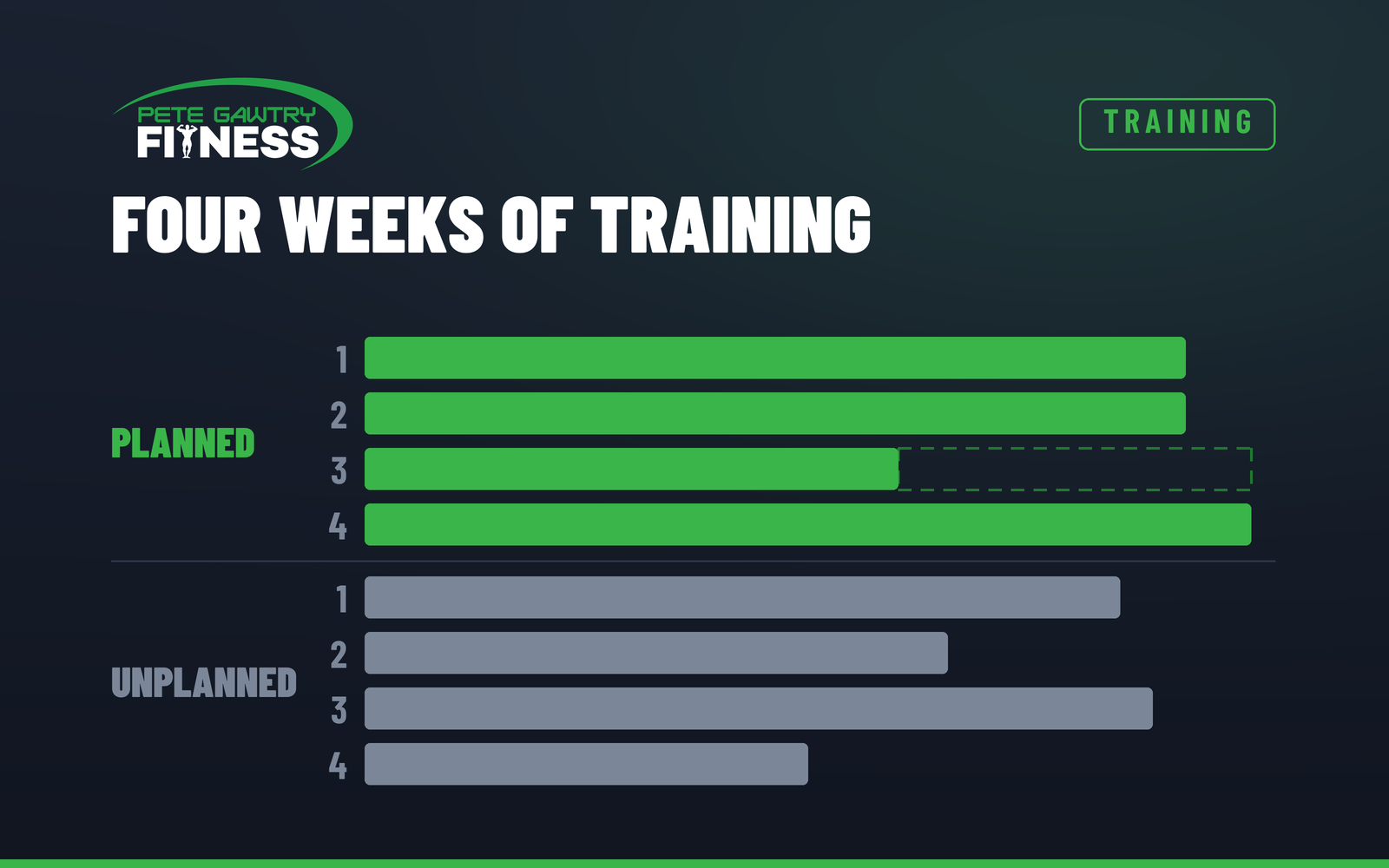
Now knock the last two exercises off. Take an extra ninety seconds between every set so the session runs long and you cut it short. Take nine reps instead of twelve on the sets you do finish. You haven’t done a bad session. You’ve done about three-quarters of one.
Do that twice a week for a month and you’ve quietly done three weeks of training in four weeks of gym visits. And that’s before you factor in the one you didn’t get to at all.
Progressive overload is the whole engine of strength work. You add a bit of weight, or a rep, or a set, and you keep asking for slightly more than last time. Simple enough, and there’s no way round it. But it only works if the work happens. Three-quarters of a session, repeated, asks for less than last time, and less is what you’ll get back.
The Food Side, Which Is The Bigger One
Fat loss is led by what you eat, with lifting building and holding the muscle underneath. Cardio is optional and it’s never been the engine. I’ve written that out properly in fat loss without cardio if you want the long version. Which means anything that quietly wrecks your eating hurts you more than anything that quietly wrecks your training.
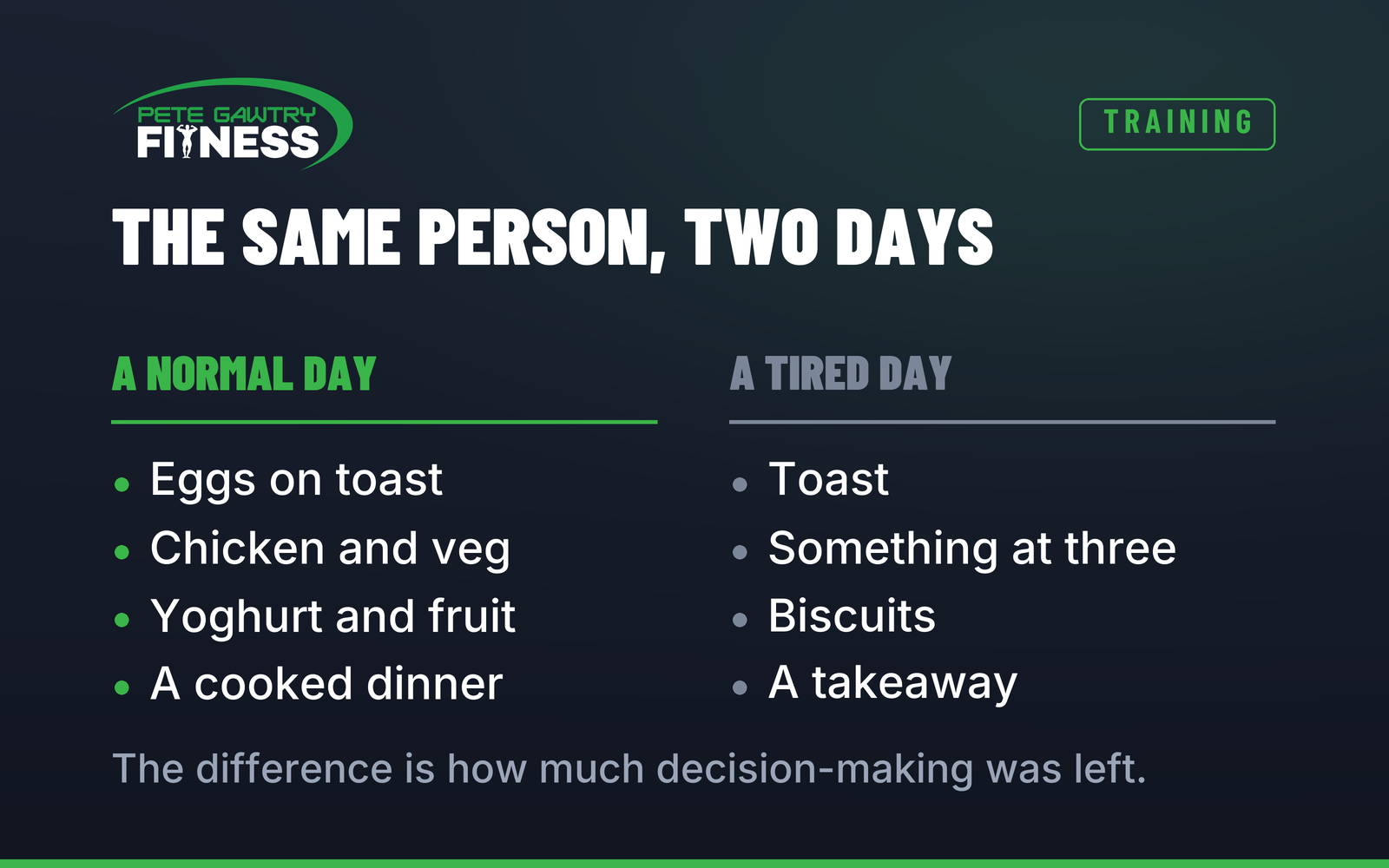
And that’s exactly what a run of short nights does, which is why I’d say this part does more damage than the training does. On a normal day, the protein target is easy. Two eggs, a bit of chicken at lunch, a proper dinner, done without thinking. By the third bad night in a row you’re hungrier, you fancy different food, and everything you want is quick and beige. Toast at eleven, something out of the vending machine at three, and a takeaway at seven because cooking has started to feel like a project.
I’ve heard it described the same way by a lot of clients: the food isn’t a decision any more, it’s just what happened. Nobody sat down and chose to eat two thousand extra calories over a fortnight. They were tired, and tired people make the easy choice, and the easy choice is usually the wrong one.
You can absolutely still hit your numbers on a bad week. It’s just that it goes from something you do without noticing to something you have to actively decide, four or five times a day, while feeling rubbish. That’s a lot of decisions to win.

The Consistency Problem
In fifteen years of doing this I’ve watched very few people quit at the gym. They quit at the alarm clock, and that’s what ends more programmes than anything else on this page.
The six o’clock session doesn’t get abandoned halfway through. It gets abandoned at ten past five, in the dark, when the alternative is another forty minutes in a warm bed and you’ve been running on empty since Tuesday. And that’s a completely reasonable decision to make once. The trouble is it gets easier every time you make it. Miss two, and the third is barely a decision at all. By the fourth week you’re a person who used to train.
Motivation runs out, and being tired runs it out faster. This isn’t a discipline failure and I don’t treat it as one. But it’s worth naming, because people beat themselves up about willpower when the actual problem was that they’d had five hours’ sleep four nights running and were never going to win that argument with the alarm.
Technique Drifts Before You Notice
This last one is about attention, and it’s the one I’d most want you to take seriously. Lifting well takes concentration. Not enormous amounts, but some. Where your feet are, where the bar sits, whether you’re actually controlling the weight on the way down or just letting it fall and catching it. Tired people are worse at all of that, and they don’t feel any less capable while it’s happening.
So the reps get sloppier and the sloppiness doesn’t announce itself. That’s usually when somebody tweaks something, and a tweak costs weeks.
If you’re genuinely short on sleep, that’s the week to keep the weights honest rather than chase a personal best. And if something actually hurts, stop and get it looked at properly. Training through real pain is never the answer, and it’s not something to work out from an article.
What To Do After One Bad Night
Don’t cancel. The session you get on four hours’ sleep is worth far more than the session you don’t do, and if you take one thing away from this piece, take that. What has to change is what you’re trying to achieve with it. Here’s what I’d tell a client.
- Change the goal of the session. Today is not the day you beat last week. Today the goal is to do the work at last week’s weights and go home. That’s a win, and it keeps the streak alive.
- Protect the compound movements. Squats, hinges, presses, rows. Do those properly, first, while you’ve got something in the tank. If time or energy runs out, lose an accessory exercise from the end rather than shaving reps off everything.
- Keep the sets honest but don’t grind. Take them somewhere genuinely hard. Don’t take them to the point where the last rep looks like a car crash.
- Don’t fix it with a triple espresso and a heavier day. Caffeine will make you feel ready for a weight you’re not ready for. That’s how the ugly rep happens.
- Hit your protein anyway. This is the day a shake earns its money. If cooking feels like too much, don’t cook. Get something quick with a decent amount of protein in it and stop worrying about whether it’s impressive.
- Don’t nap for two hours at five o’clock. You’ll feel better for an hour and you’ll wreck that night as well, and then it’s a run rather than a one-off. Twenty minutes early afternoon, or nothing.
What To Do About A Run Of Bad Weeks
A whole bad fortnight is a different problem, and it needs a decision rather than a fudge. Pull the volume back on purpose. Keep the weights where they are, drop a set from each exercise, and get through it. Four exercises done properly beats seven done at seventy percent.
The reason to do it deliberately is that otherwise it happens to you anyway, in a worse form. You’ll turn up, half the session will quietly disappear, and you’ll have no idea what you actually did or why nothing’s moving. A planned lighter fortnight you can build back from. An accidental one just looks like failure.
Then when the nights sort themselves out, go back to the full sessions and start adding again. You’ll usually find the weights are still there.
The Honest Caveat
I’m not going to tell you sleep is why you’re not progressing. That would be lazy and it usually isn’t true.
Most stalls have far more boring explanations, and I’d check these first, in this order:
- You’re not eating enough protein. By a mile the most common one. Here’s the actual number.
- You’re not adding anything. Same weights, same reps, month after month. If nothing’s gone up, nothing’s going to change.
- You’re missing more sessions than you think. Count them. Actually count them, over eight weeks, not from memory.
- The programme never changes, or changes every week. Both are problems. You need long enough on something to get better at it, and then you need it to move on.
- You’re in a big calorie deficit and expecting your lifts to climb. That’s a hard ask. Pick one.
Work through those honestly. If all five look fine and the numbers still won’t shift, then sleep is the one nobody’s checked, and it’s worth a look.
How This Comes Up In Coaching
It’s a question on the intake form and it’s a question every time somebody stalls. Not because I’ve got a sleep programme to sell you, because I haven’t. It’s because when I know somebody’s had a bad fortnight I can plan a sensible fortnight around it instead of writing them a harder programme they’ve got no chance of completing.
That’s most of what a coach is actually for, far more than picking the exercises. Knowing when to push and when to hold, and making sure the month adds up even when a couple of the weeks don’t.
If you want the wider picture on sleep itself rather than the training side, I’ve written that separately: how much sleep do you actually need. And if your nights have been bad for a long stretch, that’s a GP conversation, not one for me.
Quick FAQ
Should I skip the gym if I’ve slept badly?
Usually not. A slightly reduced session is worth far more than a missed one, and missing one makes missing the next easier. Go, do the main movements properly at last week’s weights, drop an accessory exercise off the end if you need to, and go home.
Will bad sleep stop me building muscle?
I can’t tell you what’s happening inside your body and I won’t pretend to. What I can tell you is what I see: sessions get shorter, weights stop going up, protein gets missed and whole sessions get skipped. That’s more than enough on its own to flatten your progress.
How long does it take to get back on track?
In my experience, once the nights settle down, most people are back to their normal sessions within a week or two and the weights are still where they left them. Strength doesn’t vanish over a rough fortnight. It’s the months of half-sessions that cost you.
Should I train later in the day if I’m not sleeping well?
Worth trying. If a six o’clock start is the thing you’re always missing, moving your sessions to lunchtime or the evening may simply be a better fit for your life. The best session time is the one you actually turn up for.
Is it my sleep or is it my programme?
Check the boring things first: protein, whether you’re actually adding weight or reps, how many sessions you’ve genuinely done in the last eight weeks, and whether you’re trying to get stronger while eating in a big deficit. If all of that looks right, then look at your nights.
Does hard training make it harder to sleep?
Some people find a very late, very hard session leaves them wired for a while afterwards. If that’s you, try moving the heaviest sessions earlier in the day and see whether it makes a difference over a couple of weeks.
Key Takeaways
- A single bad night costs almost nothing. A run of them shrinks every session by a bit, and the sessions are where the progress lives.
- The damage shows up as three-quarters of a session done repeatedly, not as one dramatic failure.
- The food side does more harm than the training side. Tired people eat differently, and food leads fat loss.
- Most people don’t quit at the gym. They quit at the alarm clock.
- Concentration drops before you notice it and technique drifts with it. That’s when people tweak something, so keep the weights honest on a bad week.
- After one bad night, go anyway and change the goal: last week’s weights, main movements first, drop an accessory rather than shaving every set.
- After a bad fortnight, cut the volume deliberately rather than letting it get cut by accident. Then build back.
- Check protein, progression, attendance and your deficit before you blame your sleep. Sleep is the one to look at when the obvious things are already right.
Tracking It, If You Want To
Clients I coach can log their nights in the app — bed time, wake time, how they felt waking up. It works out a score from how long you slept and, just as importantly, how steady your times are.
It’s built to be honest about itself: where it can’t measure something, it says so rather than filling in a number. Most of the value isn’t the score anyway. It’s that we can both see the pattern across a month instead of trying to remember it.
When The Month Doesn’t Add Up
Most plateaus aren’t a programme problem. They’re a “the last six weeks didn’t go the way you think they went” problem, and that’s easier to fix with someone watching it with you. 1-2-1 coaching at the studio in Suite 1, Arena Business Park, Tarn Lane, Leeds, LS17 9BF, or online across the UK. 12 awards, 4× UK’s Best PT.
Book a Free Consultation →