
Ultra-Processed Food: What Actually Matters
Around 54 percent of the calories British adults eat now come from ultra-processed food. Here’s what the label really means, what the evidence genuinely shows, and the part almost everyone online is getting wrong.
A client told me last week she’d binned her high-protein yoghurt because an app flagged it as ultra-processed. Two days later someone else asked me, completely seriously, whether bread was off the table now.
Ultra-processed food, or UPF, is the biggest conversation in nutrition right now and it’s easily the thing I get asked about most. Parliament is pushing for processing levels to appear on packaging. The Food Standards Agency has published guidance for shoppers. Every other post on your feed has a list of foods to “never eat again”.
Here’s my honest position after reading the actual research rather than the headlines: there is something real here, and it matters. But the word “ultra-processed” is being asked to do far more work than it can handle, and treating it as a purity test is making people anxious about foods that were never the problem. The useful version of this conversation is more specific, and a lot less frightening, than the version you’re being sold.
What “Ultra-Processed” Actually Means
The term comes from something called the NOVA classification, developed by a team led by Carlos Monteiro at the University of São Paulo. It’s important to understand what it does, because it isn’t what most people assume. NOVA doesn’t sort food by how healthy it is. It sorts food by how much industrial processing it has been through. Those are two different questions, and conflating them is where nearly all the confusion starts.
There are four groups.
The Four NOVA Groups
NOVA sorts by degree of processing, not by nutrition. That distinction explains almost every argument about UPF.
Unprocessed
or minimally so
- Meat, fish, eggs
- Fruit, veg, pulses
- Milk, plain yoghurt
- Rice, oats, nuts
Ingredients
things you cook with
- Oils and butter
- Sugar, honey
- Salt, vinegar
- Flour
Processed
group 1 + group 2
- Tinned fish, beans
- Cheese
- Bacon, cured meat
- Simple bakery bread
Ultra-processed
industrial formulations
- Crisps, biscuits
- Fizzy drinks
- Most ready meals
- …and protein bars
Group 4 is defined by industrial ingredients and processes you’d never have in a home kitchen — protein isolates, modified starches, emulsifiers, flavourings. Note that the last line of group 4 contains something most people think of as a health food. That is not an accident, and we’ll come back to it.
Group 4, the ultra-processed one, is roughly this: a food made mostly from substances extracted from foods rather than the foods themselves, put together using industrial processes and ingredients you would never find in a domestic kitchen. Protein isolates. Modified starches. Emulsifiers, thickeners, colourings, flavourings, sweeteners. If the ingredients list reads like a chemistry set and half of it isn’t something you could buy on its own, you’re probably looking at group 4.
Note what that definition does not mention: calories, sugar, salt, fat, fibre or protein. It’s a definition about manufacturing. Hold onto that, because it explains everything that follows.
Britain Is A UPF Country
Analyses of the National Diet and Nutrition Survey, the big government survey of what we actually eat, put ultra-processed food at roughly 54 percent of the calories British adults were getting across the survey years studied. Some analyses of earlier waves land closer to 57. For teenagers it’s higher again, around two thirds, which is among the highest in Europe. Nobody re-measures this monthly, so treat it as the shape of the national diet rather than today’s exact reading.
That number matters more than any individual food does. When more than half the national diet sits in one category, “just avoid it” stops being advice and starts being a fantasy. Anyone telling you to cut ultra-processed food to zero is describing a life most people can’t actually live, and the guilt that follows is its own problem.
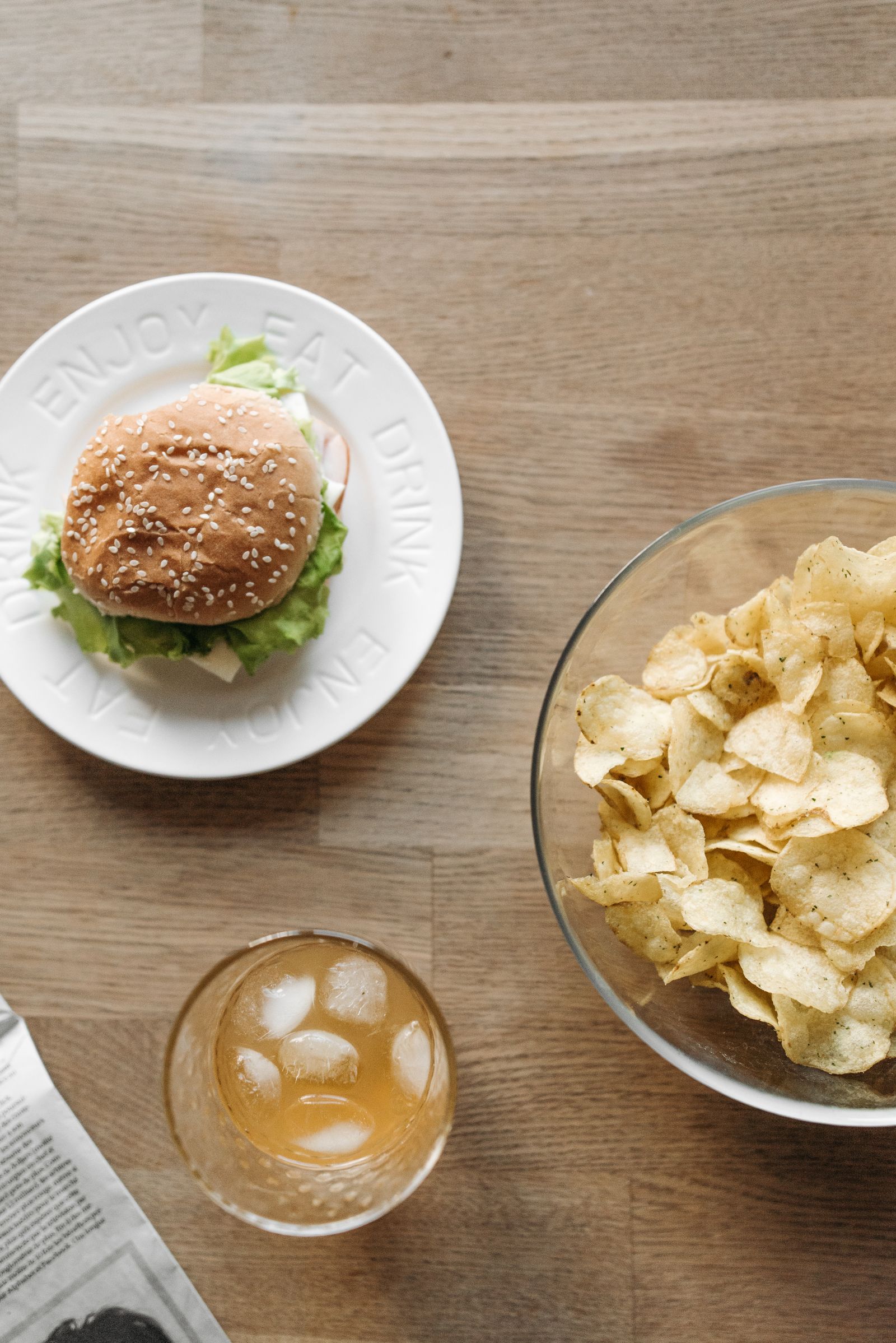
The Study That Made Everyone Take This Seriously
Most of what you read about UPF comes from observational research, which can only show that two things travel together. There is one study that goes further, and it’s the reason I take the topic seriously at all.
In 2019, Kevin Hall and his team at the US National Institutes of Health published a trial in Cell Metabolism. Twenty adults lived on a metabolic ward, where every scrap of food could be weighed and measured. Each person spent two weeks eating an ultra-processed diet and two weeks eating an unprocessed one, in a randomised order, so everybody acted as their own comparison.
The clever part is what they controlled. The two menus were matched on the headline numbers: the calories put in front of people, overall macronutrients, sugar, salt, fibre and energy density. Everyone was offered roughly twice what they needed and simply told to eat as much or as little as they wanted.
Hall 2019: Same Meals On Paper, 500 Calories Apart
Average daily calories eaten when people were free to eat as much as they liked. Both menus were matched on the headline numbers: presented calories, energy density, sugar, fat, salt and fibre.
Nobody was counting calories or restricting portions. The difference came from how much people chose to eat. Source: Hall et al., Cell Metabolism, 2019.
People ate about 500 calories a day more on the ultra-processed diet. They gained weight on it, and lost around 0.9 kg in a fortnight on the unprocessed one, without counting a single thing.
That’s a genuinely important finding and I don’t want to talk anyone out of it. It suggests the form food arrives in changes how much of it you eat, independently of the numbers on the label. It’s also one small study of twenty people over four weeks, which is worth remembering before anyone builds a religion on it.
And it’s worth being straight about what the study could not separate, because this is where most people over-read it. The two menus matched on paper, but the actual food was not equivalent. Once you take the drinks out, the ultra-processed meals were close to twice as energy dense. The fibre totals matched, but the type of fibre and the structure of the food it came in did not. So Hall’s trial does not show that “processing” or an additive made people overeat. It shows that that food environment did, and the most obvious suspects are density, texture and speed rather than anything on the ingredients list. Which, conveniently, is exactly where the rest of this article is heading.
What The Big Reviews Found, And What They Didn’t
In March 2024 the BMJ published an umbrella review, which is a review of reviews. It pooled 45 separate analyses drawn from a headline total of just under 9.9 million participants, and found ultra-processed food intake was associated with 32 of the 45 health parameters examined, spanning mortality, cancer, cardiovascular, metabolic, gastrointestinal, respiratory and mental health. (That 9.9 million is a nominal total rather than 9.9 million separate people: the same big population studies get counted again for each outcome they appear in.)
The strongest links, the ones the authors graded as convincing, were a roughly 50 percent higher risk of cardiovascular-related death, a 48 to 53 percent higher risk of anxiety and common mental disorders, and about a 12 percent higher risk of type 2 diabetes.
Those headlines went everywhere. Here’s the part that mostly didn’t.
I’d rather tell you that than pretend the science is tidier than it is. The pattern is real and it points the same way across a lot of data. It just isn’t the same thing as proof that a specific biscuit gave someone a heart attack.

Where The Label Falls Apart
This is the bit I most want you to take away, because it’s what stops the whole conversation being useful.
Because NOVA classifies by processing rather than nutrition, group 4 ends up containing things that are genuinely good for you sitting right next to things that clearly aren’t. Wholemeal supermarket bread is ultra-processed. So is tinned baked beans in sauce, high-protein yoghurt, most fortified breakfast cereals, a lot of protein powders, and the protein bar you eat because you’re trying to be good. They land in the same box as a packet of biscuits and a bottle of cola.
And it works the other way too. A cake you bake at home from butter, sugar, flour and eggs is not ultra-processed. Neither is lard, or a pile of white sugar. Nobody sensible thinks that makes them health foods.
All Of These Are Technically Ultra-Processed
Same NOVA group. Very different effect on your body. This is why “is it UPF?” is the wrong question to shop by.
All NOVA group 4
- High-protein yoghurtHigh protein, filling, portion ends. Genuinely good for you.
- Wholemeal breadFibre, some protein, slices that stop. Never the problem.
- Baked beansFibre and protein in a tin. Cheap and useful.
- Protein barDepends entirely on the bar. Often confectionery with a health halo.
- Crisps, biscuits, colaEasy to eat fast, hard to stop. This is the actual problem.
The useful question isn’t which box a food sits in. It’s whether the food feeds you or makes you eat more than you meant to.
Even the people who built NOVA would say the bluntness is deliberate, and they have a fair point: these products do share an industrial DNA. But if you’re standing in an aisle trying to feed a family, a category that puts skyr and Coca-Cola on the same shelf isn’t giving you enough to go on.
So What Is Actually Doing The Damage?
This is the more useful question, and the research points at a handful of things that have very little to do with the word “processed” and everything to do with how a food behaves when it meets your appetite.
- Energy density. Calories per gram. Ultra-processed food is usually dry, fatty and light, so a lot of calories take up very little room in your stomach. This has the strongest evidence of the lot.
- How fast you can eat it. Soft, low-fibre food needs almost no chewing. You can put away 600 calories of crisps in four minutes. Your fullness signals take roughly 20 minutes to arrive, so the food is gone long before your body has a say.
- Hyper-palatability. Fat and sugar together, or fat and salt together, in combinations that barely exist in nature. These are engineered to be moreish, and they are very good at it.
- Not much protein or fibre. The two things that actually make you feel full. If a food gives you neither, you finish it and you’re still looking.
- Portions that don’t end. A sharing bag has no natural stopping point. An apple does.
Look at that list again and notice something. Every single item describes a product that is easy to overeat. Not poisonous, not toxic. Easy to overeat. That’s the mechanism, and once you see it you can spot the problem foods without an app, because the ones that tick three or four of those boxes are exactly the ones you already suspect.

It also explains the wholemeal bread problem neatly. Bread is technically group 4, but it has fibre, it has a bit of protein, it comes in slices that end, and nobody eats nine of them by accident. The category says danger. The mechanism says it’s fine.
The Supermarket Test I’d Actually Use
Forget the classification. Four questions, and you can do them in the time it takes to pick something up and turn it over.
Four Questions That Beat “Is It UPF?”
Per 100g, on the back of the packet. This works in any shop, on any budget, without an app.
How much protein?
Per 100g. Over 10g is a proper food. Under 5g and it’s mostly a snack, whatever the front of the box says.
How much fibre?
Over 6g per 100g is genuinely good. Fibre is most of what separates real food from engineered food.
How fast can I eat it?
If it needs no chewing, it’ll be gone before your body notices. Soft and dry is the combination to watch.
Does the portion end?
A sharing bag has no full stop. Buy the size you intend to eat, not the one that’s better value.
Three or four red flags and you’re holding something designed to be overeaten. One or two and it’s almost certainly fine.
Run your protein yoghurt through that. High protein, portion ends, takes a while to eat. It passes comfortably, and it’s still ultra-processed. That’s the whole point.
Five Things People Are Getting Wrong
Myth: Ultra-processed food is toxic.
Reality: The best evidence points to overeating, not poisoning. The Hall trial didn’t find people getting ill in a fortnight. It found them eating 500 calories a day more without noticing. Over years, that’s more than enough to explain a lot of the harm, and it needs no toxins at all.
Myth: All ultra-processed food is equally bad.
Reality: Tinned beans and a bottle of cola are in the same NOVA group and will do completely different things to your week. Treat the group as a prompt to look closer, not a verdict.
Myth: If it’s not ultra-processed, it’s healthy.
Reality: Butter, sugar, lard and a home-made Victoria sponge are all outside group 4. The classification was never a health score and was never meant to be read as one.
Myth: It’s the additives and emulsifiers doing the damage.
Reality: This is the most-shared claim and the least well-supported one. There is early research worth watching on certain emulsifiers and the gut, but it is nowhere near as solid as the evidence for energy density, eating rate and low satiety. If you’re worrying about an E number while eating a 900-calorie meal deal in six minutes, you’re worrying about the wrong end.
Myth: You need to eliminate it.
Reality: It’s over half the national diet. Elimination isn’t a plan, it’s a stress. Shifting the ratio is a plan, and it’s the one that actually survives a Tuesday.

What I’d Actually Do
If you came here wanting a list of banned foods, I’m sorry, I haven’t got one. What I’d do instead is this.
Fix the big rocks first. Get protein to a sensible level at every meal and get some fibre in. Do that and the ultra-processed question mostly answers itself, because you’ve filled up on the things that satisfy you. I’ve written separately on how much protein you actually need and on the fibre conversation, and between them they’ll do more for you than any list of forbidden packets.
Go after the worst offenders, not the category. For most people I work with, the damage is concentrated in a small number of places: fizzy drinks and juice, crisps and biscuits in the evening, the meal deal, and the bag that gets opened in front of the telly. Sort those four and you’ve done the vast majority of the available good, and you haven’t had to think about bread once.
Slow the eating down. It sounds soft, and it’s one of the most effective things I ask people to do. Put the fork down between mouthfuls. Eat away from a screen. You cannot outrun a 20-minute satiety signal, but you can give it time to catch up.
Cook one more meal a week than you do now. Not seven. One. Then two. If you want the thinking behind that done for you, the free recipe books are there, and my meal plans include the actual recipes rather than just a list of macros.
Use the convenience food that works for you. Frozen veg, tinned fish, tinned pulses, pre-cooked rice, plain frozen chicken. Some of it is processed, some of it is ultra-processed, and all of it has helped more of my clients eat better than any elimination rule ever has. Convenience isn’t the enemy. Convenience that makes you overeat is.
If eating out is where your week comes undone, this one is for you. If you’d rather never log a calorie again, try hand portioning or calorie counting without the spreadsheets.
The Honest Summary
There is a real effect here. Food that is soft, dry, moreish, low in protein and fibre, and sold in portions that never end will make you eat more than you intended, and the best trial we have shows it doing exactly that under controlled conditions. Over years, that matters.
But “ultra-processed” is a manufacturing term standing in for a nutritional one, and it isn’t up to the job. It condemns your wholemeal loaf and waves through your home-made cake. If you use it as a purity test you’ll end up anxious, poorer, and no better fed.
Use the mechanism instead of the label. Ask whether a food feeds you or whether it’s built to be overeaten. That question is honest, it works in any supermarket in the country, and you don’t need anyone’s app to answer it.

Common Questions
Is bread ultra-processed?
Most supermarket bread is, yes, because of the emulsifiers and improvers used to make it keep. That doesn’t automatically make it a problem. Wholemeal bread brings fibre, a bit of protein and a portion that ends, and it has never been the reason anyone I’ve coached got stuck. A simple bakery loaf sits in group 3 if you’d rather, but don’t lose sleep over the difference.
What about protein powder and protein bars?
Technically ultra-processed, both of them. Protein powder is close to the ideal case for it: high protein, no real ability to overeat it, genuinely useful for people who struggle to hit their protein from food alone. Protein bars are more mixed, because plenty of them are confectionery with a health halo. Turn the bar over and use the four questions.
Should I be avoiding emulsifiers?
There is early research on certain emulsifiers and the gut lining that is worth keeping an eye on, but it is a long way from settled and much of it is animal work. I wouldn’t reorganise your shopping around it yet. Energy density, eating rate, protein and fibre are where the evidence is strong and where your results will come from.
Is ultra-processed food the reason I can’t lose weight?
It might well be part of it, and usually through calories rather than anything mysterious. If a big share of your intake is easy to eat quickly and low in protein and fibre, you’ll be hungrier on the same calories and you’ll drift over without ever feeling like you’ve overeaten. That’s a fixable problem and it doesn’t require perfection.
Do I need an app to scan my food?
No. Most of them just tell you a food is ultra-processed, which as you’ve now read is the least useful thing you can know about it. The back of the packet has better information on it and it’s free.
Where This Comes From
- Hall KD et al. Ultra-Processed Diets Cause Excess Calorie Intake and Weight Gain: An Inpatient Randomized Controlled Trial of Ad Libitum Food Intake. Cell Metabolism, 2019.
- Lane MM et al. Ultra-processed food exposure and adverse health outcomes: umbrella review of epidemiological meta-analyses. BMJ, March 2024.
- Monteiro CA et al. The NOVA food classification system, University of São Paulo.
- Analyses of the UK National Diet and Nutrition Survey (NDNS) on ultra-processed food intake in UK adults and adolescents.
- Food Standards Agency consumer information on ultra-processed foods.
Stop Guessing At Your Food
No banned lists, no purity tests — just a plan built around what you’ll actually eat. 1-2-1 coaching at the studio in Suite 1, Arena Business Park, Tarn Lane, Leeds, LS17 9BF, or online across the UK. 12 awards, 4× UK’s Best PT.
Book a Free Consultation →